The Polar Bear Song is catchy tune by science teacher Tom Rugg, which contains a gentle message about climate change. The Polar Bear Music Video forms part of the bbc wales green season of programming.
Showing posts with label Environment. Show all posts
Showing posts with label Environment. Show all posts
Thursday, December 17, 2009


Wednesday, May 13, 2009
The Young Leaders' Summit on Northern Climate Change
Are you 18-30 years old? Are you concerned about climate change and what it means for the future? Do you want to make your voice heard and be part of the solution? The Young Leaders' Summit on Northern Climate Change is your opportunity!
August 17–20, 2009
Inuvik, Northwest Territories
August 17–20, 2009
Inuvik, Northwest Territories
Wednesday, April 22, 2009
New Strawbale House at Craik
As the snow finally melts off the Prairie, a new house is being build in the Craik Enviro Village called Riverstone Studios. The foundation was poured in the shape of a three leaf clover last year and my understanding is it will offer two studios and a central living quarters.This house is using a post and beam construction different from the more basic straw bale wall without wood shown in a previous example. The first image shows three of the houses.
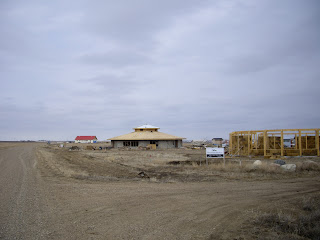 The next picture is a closeup of the construction on two of the sections.

Finally here is a picture of either a garage or a power generation station with solar panels in the roof that is behind the house.
 I can't wait for my next trip to see how the houses are progressing.
 The next picture is a closeup of the construction on two of the sections.
Finally here is a picture of either a garage or a power generation station with solar panels in the roof that is behind the house.
 I can't wait for my next trip to see how the houses are progressing.
Wednesday, April 8, 2009
Nuclear Power: We have much better choices
Ryan Meili calls on NDP MLAs to oppose SaskParty uranium resolution.
On Thursday, the Saskatchewan Legislature will debate a motion by Meadow Lake MLA Jeremy Harrison supporting the development of nuclear generation in Saskatchewan. NDP leadership candidate Ryan Meili has issued the following statement.
On Thursday, the Saskatchewan Legislature will debate a motion by Meadow Lake MLA Jeremy Harrison supporting the development of nuclear generation in Saskatchewan. NDP leadership candidate Ryan Meili has issued the following statement.
The Wall government’s uranium resolution falsely frames the debate on nuclear energy and uranium development.
Nuclear power is not a viable solution to Saskatchewan’s energy needs. It is too expensive. It is too risky. It is too slow. We have much better choices.
I am calling on all 20 New Democratic Party MLAs to vote “no” on this misleading motion.
Nuclear power is being sold to us as a means to provide cheap energy, as a means of addressing immediate energy needs, even as a means of protecting our environment.
But none of these sales pitches are based on the facts.
• Nuclear power isn’t cheap. A nuclear reactor is a very expensive undertaking and the people of Saskatchewan will pay for it on their electricity bills for a long time to come, if it is allowed to be built. We pay 10 cents per kilowatt hour for electricity now. Whether its Bruce Power or SaskPower, no one will build a nuclear reactor in Saskatchewan for less than 20 cents per kilowatt hour – double the current price of electricity. That simple fact is why most private sector utilities in the United States have been avoiding nuclear power – they know there are too many hidden costs and that most nuclear power construction projects have huge cost over-runs. Add to that expensive repair bills, the high cost of disposing of radioactive nuclear fuel waste and the very high cost of decommissioning a radioactive reactor core. When compared to wind power at 11 cents per kilowatt hour and electricity conservation at less than 6 cents per kilowatt hour, nuclear power’s economics make no sense.
• Nuclear power puts our environment at risk. Yes, nuclear power can reduce the carbon footprint. But that assumed you ignore the massive carbon emissions involved in building the reactor – particularly if it is built in a remote area. A nuclear reactor will also produce intensely radioactive waste materials which no country on earth has successfully disposed of. Why should the next generation of Saskatchewan residents bear the burden of disposing of this radioactive waste material, with the worry that it must be kept out of ground water supplies for tens of thousands of years into the future.
• Nuclear power doesn’t address our immediate energy needs. Nuclear reactors are not designed and built quickly. Sites are not chosen quickly. Even if the process started today, it would be nearly 20 years before a proposed nuclear facility contributed a single watt to the energy grid.
Wednesday, March 18, 2009
Why do we have so much trouble listening to Science?

"It's as if scientists know a bomb will go off, but can't find the right words to warn the people who might be able to defuse it." - Marlowe Hood
Read the article Climate change blues: how scientists cope from the Vancouver Sun.
Tuesday, March 17, 2009
Earth Hour March 28th, 8:30

"Earth Hour is a symbolic event. Turning off our lights for an hour won’t stop climate change but it does demonstrate that our individual action is important and adds up to make a big difference. More importantly, it sends a very powerful message to government and world leaders that people want policies and regulations put in place that can achieve meaningful emission reduction to help fight climate change."
Read more at Earth Hour Canada.
Thursday, February 26, 2009
Why I'm going to work for Ryan Meili
 Ryan Meili is running for the NDP leadership in June. He is a family doctor and community organizer; for years, he has been working to build healthier communities in Saskatchewan. Currently employed as a rural relief locum, Ryan’s job as a family doctor takes him all over the province to give doctors in small communities some much-needed and well-deserved time off. When not on the road he lives in Saskatoon’s core community of Riversdale.
This is what he says about the environment:
Building a healthier society requires a long-term vision for a sustainable relationship with our environment. Saskatchewan has been blessed with an abundance of natural resources. The way that we choose to use them is a true test of our stewardship.
To ensure that we use our resource wealth responsibly, Saskatchewan must invest heavily in the future. We have an opportunity to grow a green economy in energy production, manufacturing and conservation at a time when the world needs us to use less.
- Implement floating royalty rates to ensure that the economy continues to grow while Saskatchewan people receive fair value for their resources. Invest the wealth generated wisely and sustainably in environmental stewardship and renewable energy.
- Invest boldly in obtaining our energy needs from renewable sources such as wind, solar and hydro rather than non-renewable technologies such as coal, fossil fuels and nuclear power. This will decrease our carbon and waste footprint as well as conserving scarce resources for future generations.
- Reduce our energy needs by investing in conservation. Support retrofits for existing buildings. Incentivize and regulate new construction to promote energy efficiency, including the use of geothermal heat and solar power.
- Because transportation is one of the greatest energy users and pollution producers, we must invest in rail, public transit, bicycle and pedestrian infrastructure and high efficiency vehicles.
These changes can be made so as to benefit us both economically and environmentally. We can put the eco back in economy and grow both our prosperity and our sustainability. Not only can this shift be made, it must be made. Climate change is happening and we are contributing to it. The cumulative impact of unsafe industrial practices threatens our environment. It is not too late to change, but the time has come to use our best energies to build a greener, cleaner, healthier society.
GET INVOLVED
Wednesday, February 18, 2009
Alberta environmentalists take it to US
 This advertisement from Forest Ethics,
the Mikisew Cree First Nation
and the Athabasca Chipewyan First Nation
appeared Tuesday in USA Today. (Forest Ethics)
According to the CBC, "An anti-oilsands advertisement placed by an environmental group and two northern Alberta First Nations appeared in Tuesday's edition of USA Today, the most widely circulated newspaper in the United States."

Sunday, January 25, 2009
Reflections on "Collapse"
I've been reading Collapse: How Societies Choose to Fail or Succeed by Jared Diamond. In a nutshell, this is my take on what he is saying.

Saskatchewan has recently experienced a resource increase because of the worlds need for oil making extraction from tar sands more viable. As a result, we have been experiencing a large population increase that has driven the cost of land and housing to unexpected heights. Increasing employment opportunities have supposedly offset the increase in prices, so we have suddenly become a "have" province ready to ride out the economic downturn. So we are at our pinnacle point.
We have recently felt the inkling of crisis as trade has decreased because of less need for resources such as timber, grain, fertilizer and a fall in the price of oil.
So what does Diamond say about how a societies response to crisis leads to success or failure? What should Saskatchewan do?

Saskatchewan has recently experienced a resource increase because of the worlds need for oil making extraction from tar sands more viable. As a result, we have been experiencing a large population increase that has driven the cost of land and housing to unexpected heights. Increasing employment opportunities have supposedly offset the increase in prices, so we have suddenly become a "have" province ready to ride out the economic downturn. So we are at our pinnacle point.
We have recently felt the inkling of crisis as trade has decreased because of less need for resources such as timber, grain, fertilizer and a fall in the price of oil.
So what does Diamond say about how a societies response to crisis leads to success or failure? What should Saskatchewan do?
Friday, January 18, 2008
The RiverGreen Ecovillage in Saskatoon
RiverGreen aims to meet the exacting LEED-Platinum standard of the Canadian Green Building Council, ensuring outstanding environmental performance. Features like solar water heating, high-efficiency district heating, natural cooling, and rainwater harvesting will dramatically reduce resident's ecological footprint and greenhouse gas emissions. http://www.prairie-ecovillage.org/ or http://www.rivergreen.ca/
Saturday, December 22, 2007
From a Prairie Home Companion in the Oil Patch capital of Canada
 Our illustrious Environment Minister, John Baird, has just returned with his tail between his legs from Bali, having been pilloried with a "Fossil of The Day" award at the United Nations Climate Change Conference. And... so far the silence from the two Conservative Provincial Governments of both Alberta and Saskatchewan was, as expected, deafening.
I suspect they too refuse to make false promises they know they cannot keep!
As the Globe and Mail editor in chief, Edward Greenspon so eloquently wrote in the Dec 18th 2007 newspaper article on page A16, "Efforts to fight climate change cannot possibly succeed without strong committments from major polluters such as China and India. Those countries have still not been forced to set binding targets, but they have begun to accept more responsibility, and it is unlikely that would have occurred without pressure from Canada and other nations.
Mr Baird's claim was that Canada can play a bridge building role between the two sides. No doubt the Conservatives have taken a major public-opinion hit for their short sighted approach.
It does not help that the former Prime Minister, Jean Crétien, has been running around blaming his successors for the failure to meet the Kyoto targets, neglecting to mention that they have been saddled with the mess he left behind."
Why is it that we, the people, ever trust our elected politicians to do the "right thing" and follow up urgently on such vital international negotiations by achieving measurable results at home?
Developing a comprehensive "roadmap" by the end of 2009 is now a call for us active and inactive individuals on the Canadian Prairies to play our part in climate change activities in our home towns and cities. It also begs the obvious question of how is that going to be possible to Save Our Prairies in any part of North America without a long overdue regime change occuring in our neighbour's White House!
Since the USA has never signed on to the Kyoto Agreement with Canada now faltering in that regard, are we, the two leading members of NAFTA, not by far the worst global polluters?
I also wonder if the task of reducing greenhouse gas emissions from current levels by between 38% and 53% (this was the majority of the Bali Conference members numbers on emission reduction strategy) is not a far more personal rather than a governmental choice anyway!
Let us all do our level best to reduce our carbon footprint during this festive season.
David from Calgary
Subscribe to:
Posts (Atom)